
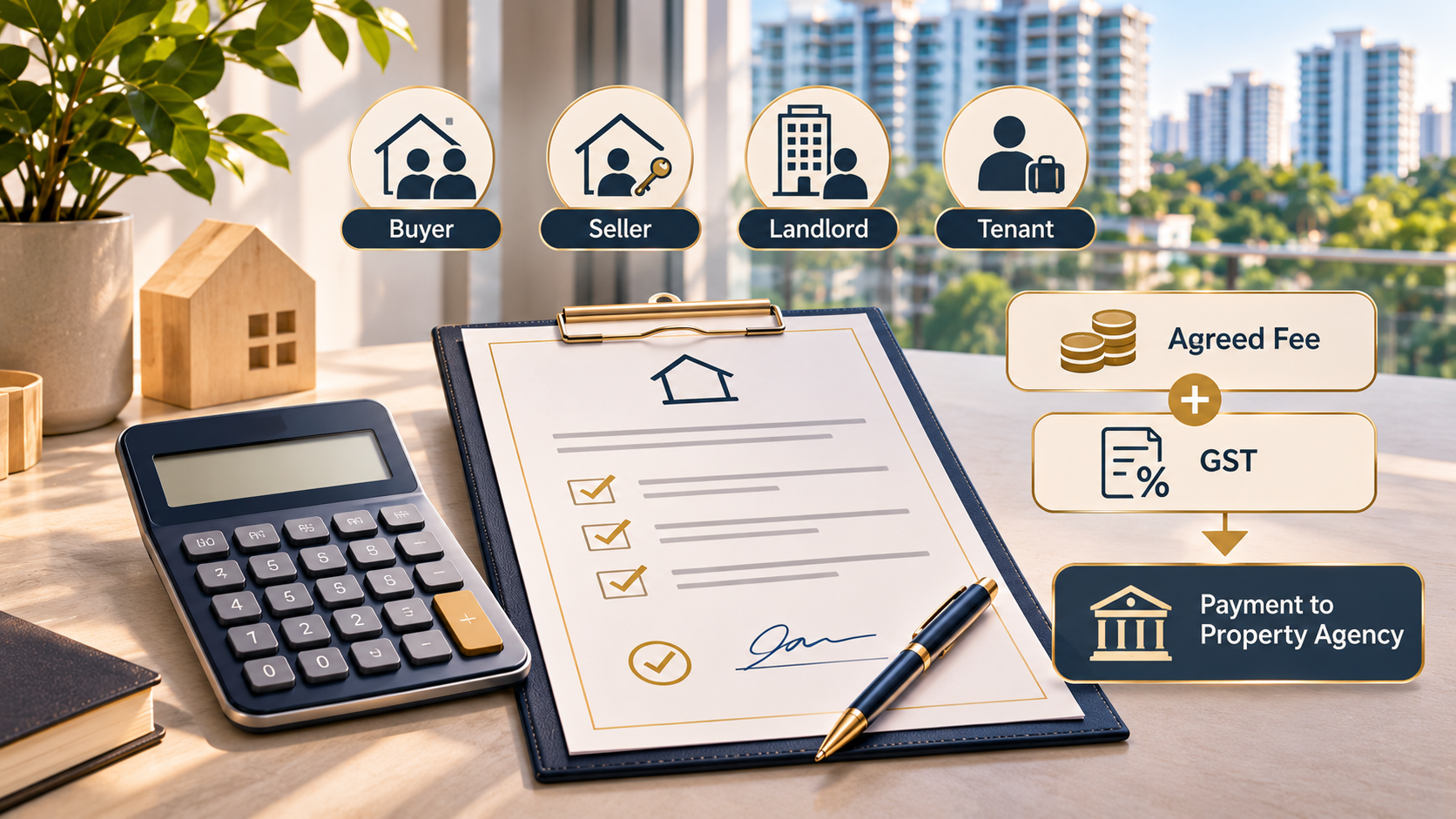
There is no fixed property agent commission rate in Singapore, and there is no single rule that says buyers, sellers, landlords or tenants always pay. Start with the appointment: who engaged which property agency, what services were agreed, and what the estate agency agreement says about the commission and payment terms.
That makes the written agreement more useful than a table of “standard rates”. Before an agent starts work, confirm the amount or calculation method, whether GST is included, when payment becomes due, and whether the appointment is exclusive or non-exclusive.
1. Property agent commission is negotiable
The Council for Estate Agencies (CEA) states that there are no fixed commission rates or prescribed guidelines on commission amounts. Consumers and property agencies are free to negotiate the amount or rate.
This means a percentage, fixed fee or other agreed calculation should be assessed together with the services being provided. A lower figure is not automatically better if it excludes work you need. A higher figure is not automatically justified without a clear scope.
Before comparing proposals, ask each agency to explain:
- the work included;
- the commission amount or calculation method;
- any separate expenses or additional services;
- whether GST is included or added; and
- when the commission becomes payable.
Record the agreed terms before work begins. Do not rely only on a message describing a “usual” or “market” rate.
2. Who pays the commission?
There is no reliable answer based only on whether someone is a buyer, seller, landlord or tenant. The payment obligation depends on the agency appointment and the agreed terms.
A seller may appoint an agency to market a home. A buyer may separately appoint an agency to search, advise and negotiate. The same applies to landlords and tenants. Each party should clarify whether its own appointment creates a commission obligation and how that agent will be paid.
CEA also explains that a property agent can represent only one party in the same transaction. An agent cannot represent and collect commission from both buyer and seller, or both landlord and tenant.
Co-broking is different. It involves agents representing different parties working together, and the sharing of commission is an agreement between the agents involved. Do not assume that a co-broking arrangement removes or creates your own payment obligation. Ask how your appointed agency is being paid and ensure that this is consistent with your agreement.
3. Buyers and sellers should check their own appointment
For a sale or purchase, CEA provides separate prescribed estate agency agreement forms for sellers and buyers, with exclusive and non-exclusive versions.
If you are selling, check what the agency will do to market the property, manage enquiries, arrange viewings, present offers and support the transaction. If you are buying, check the agreed search, viewing, due-diligence and negotiation work.
The commission clause should match the actual appointment. Before signing, ask:
- Is the commission a fixed amount, a percentage or another formula?
- What transaction value will a percentage be applied to?
- Is GST included or charged separately?
- Is payment due only when the transaction is completed?
- What happens if the transaction does not complete?
- Are advertising, photography or other expenses included?
If you have not yet verified the agent’s registration and contact number, complete our property-agent verification checklist before discussing appointment or payment.
4. Landlords and tenants should not rely on a rent-based rule of thumb
CEA also provides separate prescribed agreements for landlords and tenants. Its rental guidance states that there are no fixed commission rates or prescribed guidelines for rental transactions.
The commission should therefore be discussed in relation to the work required and recorded before the agent starts. Clarify whether the appointment covers finding a tenant or property, viewings, eligibility checks, negotiation, paperwork and handover.
CEA says a property agent’s estate-agency role generally ends after the landlord and tenant sign the tenancy agreement and the property is handed over. If the agent offers property-management help during the tenancy, such as coordinating repairs, ask whether that is a separate service and whether additional fees apply.
The same discipline applies to renewals. Do not assume that a renewal fee is automatically payable or automatically excluded. Read the agreement and any additional terms, and seek advice if the contractual position is unclear.
5. Clarify GST before comparing quotations
CEA advises consumers to clarify whether GST is included or excluded from the agreed commission. Only a GST-registered property agency may charge GST.
IRAS states that commissions received by real estate agencies for brokering services are subject to GST, regardless of whether the property is residential or non-residential. Singapore’s current GST rate is 9%.
Illustration only—not a recommended commission
- Hypothetical agreed commission: S$12,000
- GST at 9%, if chargeable separately: S$1,080
- Hypothetical total: S$13,080
The important question is not the example amount. It is whether your written agreement states the commission clearly and says if GST is included or added. When comparing quotations, compare them on the same GST basis.
6. Understand exclusive and non-exclusive agreements
CEA’s prescribed estate agency agreement is a binding contract between the consumer and the property agency. It records matters such as the agency’s duties, the agreed commission and conflict-of-interest disclosures.
Under CEA’s current guidance:
- An exclusive agreement appoints one property agency for a validity period of up to three months. During that period, commission may remain payable to the appointed agency even if the consumer completes the transaction independently or through another agency. A further provision may apply when a transaction is completed within three months after expiry with a party introduced during the exclusive period.
- A non-exclusive agreement allows more than one property agency to be appointed. The commission is payable to the agency that successfully helps complete the transaction.
Ask the agent to explain every clause before you sign, especially the commission, validity period and circumstances in which payment becomes due. Additional agreed terms should be recorded in the space provided or on the permitted additional sheet, and they cannot conflict with the prescribed terms.
Use our broader guide to selecting a property agent to compare the proposed service as well as the fee.
7. Pay the property agency, not the individual agent
CEA advises consumers to pay the agreed commission to the property agency, not directly to the individual property agent.
Before transferring money:
- Check that the transaction has reached the agreed payment stage.
- Confirm the final amount, GST treatment and invoice with the property agency.
- Verify the agency’s payment instructions through an official channel.
- Keep the estate agency agreement, invoice and payment record.
Do not pass transaction monies such as option fees, deposits, sale proceeds or rent through a property agent. CEA advises consumers to pay the relevant payee directly through verifiable means.
8. If there is a commission dispute
Start with the property agency. Put the issue in writing and identify the clause, amount, service or event in dispute. Attach the agreement, relevant messages, invoice and transaction timeline.
CEA says its Dispute Resolution Scheme may be available when the consumer has signed the relevant estate agency agreement with a licensed property agency and the dispute arises from that agreement. The scheme includes mediation and arbitration through approved independent centres.
A complaint about possible misconduct is a different route. CEA accepts complaints concerning estate agency work, including unprofessional service, misleading information, misrepresentation and other misconduct. It assesses each complaint based on the facts and supporting evidence.
For a contractual question or significant claim, consider obtaining independent legal advice rather than assuming that an online commission table resolves the agreement.
Commission checklist before you appoint an agency
Before an agent starts work, confirm:
- which party the agent and property agency represent;
- the agency’s licensed name and the agent’s CEA registration details;
- the services and transaction covered;
- the commission amount or calculation method;
- whether GST is included or added;
- any separate expenses or additional-service fees;
- when the commission becomes payable;
- whether the agreement is exclusive or non-exclusive;
- the validity period and any post-expiry commission clause;
- the correct property-agency payment channel; and
- the first step if a disagreement occurs.
If any point is unclear, resolve it before signing or allowing work to begin.
A clear agreement is more useful than a “standard rate”
Property agent commission in Singapore should be treated as an agreed service term, not a universal market rule. Clarify representation, scope, commission, GST and payment timing in writing. Then compare the proposed work and advice—not only the headline number.
For property agents, our separate commission-protection guide covers professional records, client agreements and co-broking arrangements. Consumers who would like to discuss a buying, selling or rental plan can contact Ming Property.
Prepared 3 November 2026. CEA and IRAS sources were checked on that date. This article provides general consumer information and is not legal, tax or contractual advice. Check the current official guidance and your signed agreement for your specific transaction.