
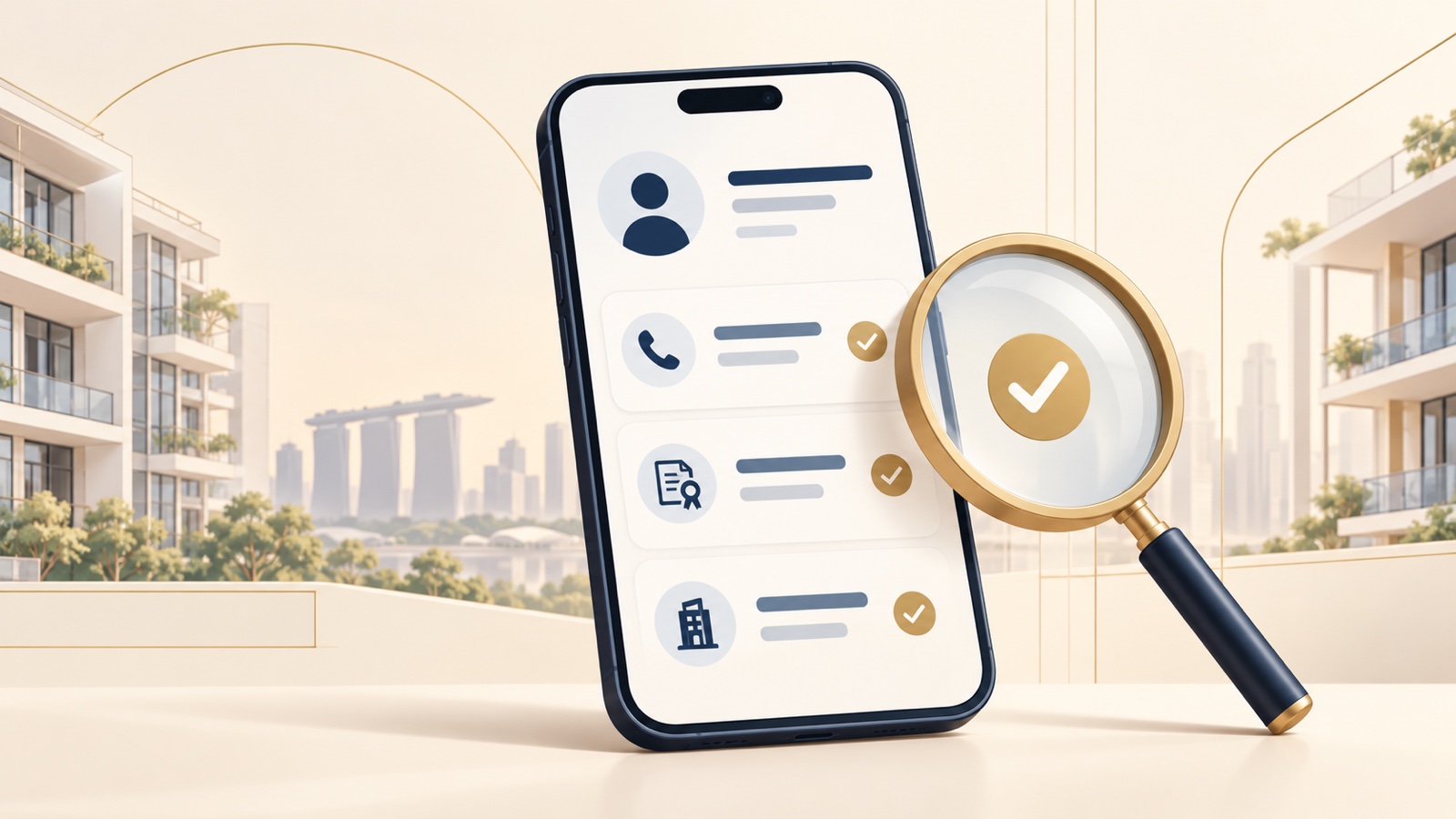
Before you discuss a viewing, appointment or payment, check the exact phone number the person is using against the Council for Estate Agencies (CEA) Public Register. A name, photograph or registration number copied from a genuine agent does not prove that the person messaging you is that agent.
In Singapore, the people commonly called property agents are registered as salespersons with CEA through licensed property agencies. This guide explains the practical checks a consumer can make before engaging one—and what to do when the details do not match.
1. Start with the official CEA Public Register
Use the CEA Public Register, rather than relying only on an advertisement, name card, messaging profile or social-media page.
CEA’s current registration-check guidance says the register can be used to confirm whether a property agent has a valid registration. A genuine profile should let you check key details such as:
- the agent’s name;
- CEA registration number;
- registered contact number;
- property agency name and licence number;
- recent residential transaction information shown by CEA; and
- any disciplinary records displayed on the profile.
Treat this as the first verification step. It helps you confirm whether the phone number being used is registered to the claimed agent’s profile. It does not by itself prove who is behind a message or tell you whether that agent’s service, communication style or plan is right for you.
2. Search the phone number being used to contact you
This is the most important practical step: enter the exact phone number shown in the advertisement or used in the message or call.
Why not search only by name or registration number? A scammer can copy those details from a real profile. The phone-number search helps you check whether the contact channel itself is registered to that agent.
If the number does not lead to the claimed agent’s profile, stop and verify independently. CEA’s guidance says the number is not registered with CEA and the advertisement or contact is likely to be a scam.
Do not accept an explanation that the number is simply waiting to be updated. CEA says changes to an agent’s contact number are reflected immediately in the Public Register.
3. Match the full profile—not just one detail
Do not stop after finding a familiar name. Check that the profile matches the person and the contact channel you are dealing with:
- Is the registration shown as valid?
- Does the registered phone number match exactly?
- Do the name and CEA registration number match?
- Does the property agency name match what the person told you?
- Does the agency licence number appear on the profile?
- If a photograph is shown, is it consistent with the person you are meeting?
One correct field does not cancel out a mismatch elsewhere. If anything is unclear, use the registered contact details from the official profile—not a link or number supplied in the suspicious message—to make a separate check.
4. Read transaction and disciplinary information in context
CEA says the Public Register may show an agent’s residential property transactions for the past two years, including whether the agent represented the buyer or seller, or the landlord or tenant. It may also show awards, accolades and disciplinary records.
This information can help you prepare better questions. For example, you may ask about recent experience with your property type or the role the agent usually represents.
Avoid turning the register into a ranking table. A transaction count does not reveal every part of an agent’s work, and the absence of a particular property type does not automatically mean the agent cannot advise you. Likewise, no displayed disciplinary record is not a guarantee of future service. Use the information as context for a conversation, not as a substitute for judgement.
5. If the details do not match, pause the conversation
When the phone number, agency or identity does not match the Public Register:
- Do not send more documents or personal information.
- Do not make a deposit, commission payment or other transfer.
- Contact the genuine agent or agency using details obtained independently from the CEA profile or the agency’s official channel.
- Keep screenshots, phone numbers, payment instructions and message records if you may need to report the matter.
- Use CEA’s feedback and complaint routes where appropriate, and contact the Police promptly if you believe you have encountered a scam or lost money.
A copied photograph, business card or CEA registration number can make a message look convincing. The mismatch is the reason to stop, not something to explain away under pressure.
6. Verification and selection are two different decisions
A register match answers a basic question: is the phone number being used registered to the claimed agent’s profile under a licensed property agency?
Choosing whom to engage requires a second assessment. Discuss the agent’s understanding of your needs, proposed marketing or search plan, communication style, availability, relevant experience and how advice will be documented.
Use our six checks before choosing a property agent for that wider discussion. Verification should come first, but registration alone should not decide the appointment.
7. Confirm representation, scope and commission in writing
Before appointing an agent, be clear about whom the agent represents. CEA states that a property agent cannot represent both parties in the same transaction—for example, both buyer and seller, or both tenant and landlord.
Discuss the scope of services and commission before work begins. Commission rates are negotiable; record the agreed amount and terms in the applicable prescribed estate agency agreement. Check whether GST applies. CEA advises that only GST-registered property agencies may charge GST.
Read whether the appointment is exclusive or non-exclusive, how long it lasts and how it can be ended. The agreement is with the property agency, even though an individual agent carries out the work. CEA’s consumer guidance on engaging a property agent explains these safeguards.
8. Keep money moving to the proper recipient
CEA advises consumers to pay commission to the property agency, not directly to the individual agent. Transaction monies should be paid directly to the relevant payee rather than passed through the agent.
For rental enquiries, CEA also warns consumers not to pay a deposit simply to view or rent a property before viewing it. Arrange to view the property with the registered agent in person, and make rental payments directly to the property owner according to the verified transaction arrangements. See CEA’s current rental-scam guidance for the full precautions.
If payment instructions suddenly change, confirm them independently before transferring money. Urgency is not a reason to skip verification.
A quick property-agent verification checklist
Before you proceed, confirm that you can answer “yes” to the relevant checks:
- I searched the exact contact number in the CEA Public Register.
- The registration is valid.
- The name, registration number, phone number, agency and agency licence details match.
- I reviewed the transaction and disciplinary information shown, without treating it as a guarantee.
- I know whom the agent represents in the transaction.
- The services, commission, GST treatment and appointment terms are clear in writing.
- I know the correct recipient for each payment.
- I have independently checked any unexpected change in contact or payment instructions.
If the identity check fails, do not move to the selection or payment stage.
Verify first, then discuss the working relationship
The Public Register check takes only a few minutes, but it creates an important boundary: first confirm who is contacting you; then decide whether the agent and proposed service suit your property plans.
After completing the official check, use our guide to selecting a property agent to structure the conversation. If you would like to discuss buying, selling, renting or property planning with Francis and Hui Ming, contact Ming Property.
Prepared 27 October 2026. CEA sources checked on that date. This is general consumer information, not independent verification of any individual or agency. Always check the live CEA Public Register and confirm transaction-specific, payment and contractual details through the relevant official or professional channels.