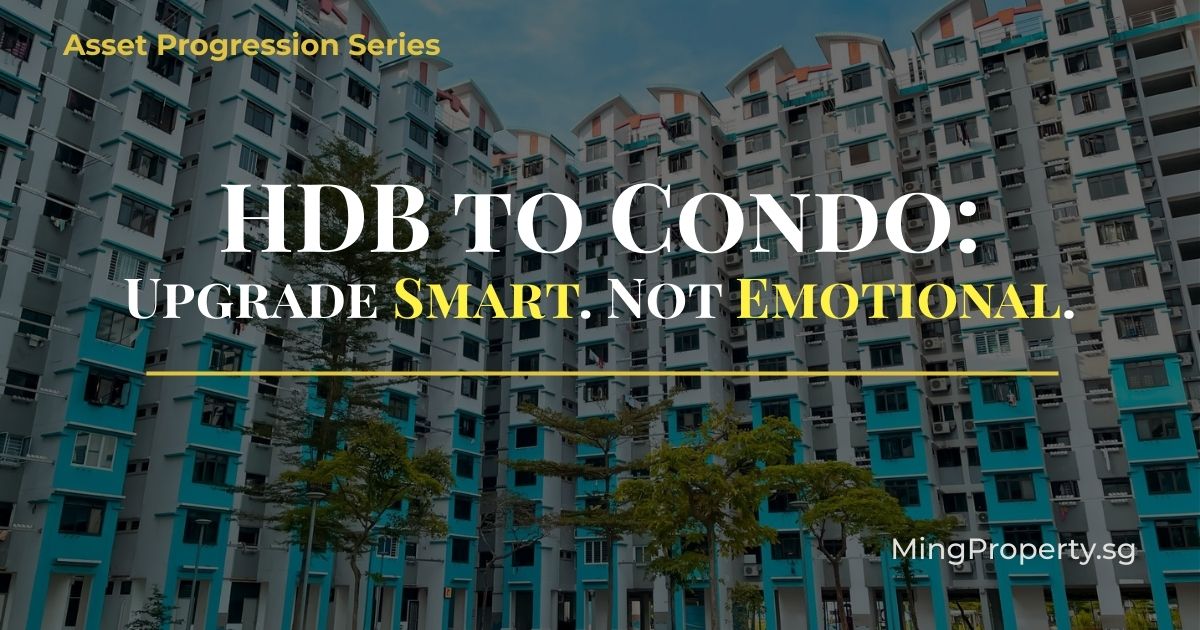
An HDB upgrade to a condo should improve your living situation without leaving your household short of cash. The right time depends on your housing needs, sale proceeds, borrowing capacity and ability to manage the transition.
Reaching the Minimum Occupation Period is a reason to review your options. It does not create a deadline to move. Start by testing whether the upgrade works at realistic prices and with room for setbacks.
- You are eligible to acquire the next property.
- Your cash and usable CPF cover the payments when they fall due.
- The new monthly commitments remain comfortable.
- Your sale and purchase dates work even if the sale takes longer than expected.
1. Decide what the upgrade needs to achieve
Write down the practical improvement you want: a shorter commute, a layout that suits your family, proximity to parents, or facilities you will use regularly.
A condo may have a smaller internal area than your current flat. Visit actual units and compare usable space, storage, privacy and daily journeys. A more expensive address is not automatically a better home for your household.
Set your minimum requirements before viewing. This helps you avoid stretching the budget for features that were never important to your decision.
2. Check your HDB eligibility first
HDB requires you and your spouse to fulfil the flat’s applicable MOP before acquiring private residential property. Check the actual date and conditions with HDB rather than counting five years from your application or assuming every flat follows the same rules.
Most unclassified and Standard flats have a five-year MOP; Plus and Prime flats have ten years. Special schemes and periods excluded from physical occupation can affect eligibility. See HDB’s selling eligibility guidance and rules on acquiring private property.
If you intend to keep the flat, confirm that your household is permitted to do so. Households where all flat owners are Singapore Permanent Residents must notify HDB before the relevant private-property OTP is exercised.
They must dispose of the flat within six months of acquiring a completed or uncompleted private residential property in Singapore.
Keeping a flat and renting it out are separate eligibility questions; do not assume that passing MOP makes both available.
3. Separate cash proceeds from CPF refunds
The selling price is not your next-home deposit. Obtain a mortgage redemption estimate, each owner’s CPF housing refund figure and estimates for agency fees, legal fees and any other sale costs.
CPF used for housing generally has to be refunded with accrued interest when the property is sold. A CPF refund remains your retirement savings, but it is different from cash available in your bank account.
At age 55 and above, housing refunds first help meet the applicable retirement sum in the Retirement Account. Confirm how much will be available for another purchase.
Use your CPF housing refund information rather than estimating from the original downpayment alone.
- Sale price
- $750,000
- Less outstanding mortgage
- $250,000
- Less required CPF refund
- $300,000
- Less assumed selling costs
- $20,000
- Illustrative cash balance
- $180,000
The $300,000 CPF refund is separate from the $180,000 cash balance. Its availability for the next home depends on the owners’ CPF rules and circumstances. These are hypothetical figures, not a quotation or a completion statement.
Repeat the calculation at a lower selling price. If a modest price reduction removes your emergency reserve, reconsider the target purchase budget.
4. Get a loan assessment before setting your price ceiling
For a private condo, ask a bank to assess your income, age, debts and intended loan tenure. Regulatory limits are ceilings; the approved loan may be lower.
MoneySense sets out a 55% Total Debt Servicing Ratio threshold. For bank housing loans, borrowers with no outstanding housing loan generally face a 75% or 55% loan-to-value limit; with one outstanding housing loan, the limits are 45% or 25%.
Longer tenure or a loan extending beyond age 65 can trigger the lower limit.
Under the 75% LTV scenario, at least 5% of the property value must be paid in cash. The remaining downpayment and all other costs still need funding.
Valuation and the bank’s assessment matter. Read the MoneySense affordability guide and obtain written confirmation for your transaction sequence.
ABSD property count and loan eligibility use different tests. Selling a property, repaying its loan and receiving its proceeds can happen at different stages. Ask your lender and conveyancer to map these stages before you commit.
5. Choose your sale and purchase sequence
Selling first
A sale secured first gives you firmer information about the price and timing. You may still need temporary accommodation, storage and an additional move. Confirm when cash and CPF funds become available before agreeing to the next purchase’s payment dates.
Buying first
Buying first may help you secure a suitable home, but it can require more upfront funding and expose you to overlapping commitments. Budget for any applicable ABSD, lower borrowing capacity and a slower HDB sale.
Eligible married couples jointly buying a second residential property, with at least one Singapore Citizen spouse, may qualify for an ABSD refund if all conditions are met.
The normal sale deadline is six months from purchase for a completed property, or from TOP or CSC, whichever is earlier, for an uncompleted property. Confirm the applicable dates and refund application requirements with your conveyancer.
A possible refund is not money available to pay the initial tax bill. Check the full IRAS married-couple remission conditions. Do not assume selling later automatically qualifies you.
For the married-couple refund, the application must also be made within six months after selling the first residential property. Confirm all ownership and disposal conditions with your conveyancer.
Our sell-first or buy-first guide explains the sequencing decision in more detail.
6. Budget beyond the mortgage
Obtain the actual maintenance contribution and review available management accounts, meeting minutes and information about planned major works. Include property tax, insurance, repairs, parking where applicable and the costs of maintaining the unit.
At purchase, allow for Buyer’s Stamp Duty, any ABSD, legal fees, renovation, furnishing and moving. Keep these separate from your emergency reserve.
For an uncompleted condo, build a payment calendar covering the construction stages and your accommodation costs while waiting. Our progressive payment calculator can illustrate the schedule; use your bank’s terms and the sale agreement for the actual commitment.
7. Stress-test the plan before paying an option fee
- Lower sale price: Can you complete the purchase without using every dollar of savings?
- Delayed sale: How long can you carry overlapping payments and accommodation costs?
- Higher interest: Does the repayment remain manageable when the loan reprices?
- Reduced income: Can the household cover essentials during a period of unemployment or unpaid leave?
- Unexpected works: Is there room for renovation overruns or additional property expenses?
Use a month-by-month cash-flow plan. A transaction can look affordable overall and still fail because a payment is due before the sale proceeds arrive.
When staying in your HDB flat may be the better choice
Consider waiting if your current home still works well, the upgrade relies on an optimistic sale price, or the new commitments would disrupt retirement savings and essential family spending.
You can review again after building savings, reducing debt or clarifying your future needs. A sustainable housing decision matters more than moving to private property on a particular schedule.
Work out your upgrade budget before choosing the condo
Francis and Hui Ming can help you compare your likely HDB sale outcome, suitable homes and a practical moving sequence. Bring your loan balance, CPF refund figures and preferred monthly budget to the discussion.
Reviewed 18 October 2026. General information for Singapore homeowners. Eligibility, CPF usage, financing and taxes depend on your circumstances and the property. Confirm your position with HDB, CPF Board, your lender and conveyancer before committing.